
Bachelor of Science in Informatics
The School of Informatics offers programs that study the interrelationship of people, information and technology to prepare students for today's digital, global economy.
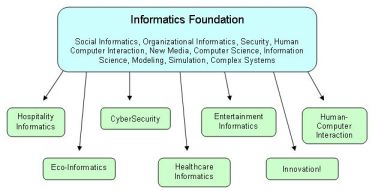
Informatics builds solid technology skills on a traditional liberal arts foundation. As such, Informatics may be viewed as an academic bridge that connects information technology to other "cognate disciplines" such as those within hotel administration, fine arts, publc health, the humanities, business and engineering. One of the strengths of Informatics is this interdisciplinary focus. Students who matriculate the program will be able to take advantage of a unique educational experience that integrates Informatics with another academic discipline of interest.
The B.S. in Informatics program is designed to produce graduates that become successful and internationally competitive educators, entrepreneurs, innovators and leaders in the global information economy.
Accreditation
Northwest Commission on Colleges and Universities
Undergraduate Major
Bachelor of Science in Informatics
Mission
The mission of the School of Informatics is to provide an academic path for students who are interested in pursuing a career that combines computing and information technology with another academic discipline. The curriculum is inherently interdisciplinary, and recognizes that the human, information and technology dimensions of problem solving are equal contributors in advanced informatics applications areas. The School of Informatics will produce graduates that become successful and internationally competitive educators, entrepreneurs, innovators and leaders in the global information economy.
Graduates from the School of Informatics will possess the skills to apply information technology deeply and effectively in related disciplines, referred to as "cognate" areas. These graduates will be ideally suited to achieve profound advances in these cognate areas. They will also possess general knowledge in the discipline of informatics, which will enable them with the principles and conceptual framework necessary to invigorate any discipline using advanced information technology.
The School of Informatics responds directly to the objectives of UNLV's Macrotheme in Informatics.
Goals
The School of Informatics will accomplish its mission by achieving the following goals:
- Achieve and sustain a world-class academic program at the undergraduate and graduate levels in Informatics.
- Prepare students for 21st century careers both integrating and applying advanced information technologies to innovate new methods and also increase the efficiency of knowledge creation in other disciplines.
- Provide graduates with a competitive advantage in the workplace by guiding the development of diverse skill sets to meet the complex and variegated challenges of the information technology industry.
- Build an internationally recognized faculty in Informatics through aggressive recruiting, retention, and advancement based primarily upon the relevance, demonstrated excellence, and international recognition of their work in Informatics.
Program Objectives
The following objectives will enable us to accomplish our goals and satisfy our mission:
- Build the instructional models around the project-based education, with particular emphasis toward the interrelationships between humans and technology, the centricity of current and future digital media, and the organizational, societal and cultural implications of what humans do with information and the technology that supports its use.
- Selectively hire and retain faculty with a history of, or strong potential for, transdisciplinary research and an commitment to our instructional model.
- Create learning environments and laboratories that are qualitatively compatible with the development and production environments in the most advanced technology industries.
- Maintain objectively documented nationally competitive programs in selective high-profile/high-demand such as entertainment informatics, digital media, health information technology, human-computer interaction, and information systems security.
- Become the focal point in selected research areas that directly support such critical components of the private sector in Las Vegas and Nevada as entertainment, gaming, hospitality, healthcare, and security.
- Establish close relationships with the local industry executives through advisory boards and cooperative programs.
- Work with local industry and government agencies to facilitate student transition into the employment market.
- Encourage strategic research partnerships between faculty and graduate students.
Admission to the Major
Minimum GPA: 3.0
Admission and transfer policies are described in the College of Engineering section.
High School Preparation
Admission requirements to the School of Informatics B.Sc. program include UNLV admission, a passion for some cognate area, and math proficiency that includes college algebra and/or discrete mathematics. Applicants should prepare themselves during the course of their high school education to meet these requirements.
Prospective Informatics students would highly benefit from taking any course that helps them expand their experience with computing and information technology, developing strengths in math, science, humanities, and art, as all play an important role in Informatics, developing their written and oral communications skills, learning a popular programming language, such as Java, C#, C++, or Visual Basic, designing and developing a Website, and learning everything they can about information technology and its impact on society.
The Freshman Year
The first year Bachelor of Science students will get acquainted with the field of Informatics by taking two introductory level Informatics courses. They will be taught the core concept of integration of people, technology and information by emphasizing on the practical dimension of Informatics, real problems, and the socio-economic situations in which they arise. The students will also be shown how Informatics interrelates with different cognate areas that they have the opportunity to choose from. They will be provided with a variety of Informatics tools from a variety of domains, and they will learn implications of these tools for science, engineering, art, the humanities and society
School Policies
- Students must complete a minimum of 30 credit hours in informatics courses at the 300-400 (junior-senior) level.
- Students must maintain a minimum GPA of 2.75. Any course taken to satisfy the requirements of the major must be completed with a minimum grade of C.
- Students are expected to complete the requirements for their undergraduate degree within eight years of admission to the School of Informatics. Students are allowed to continue beyond this time period only at the discretion of the Director. If a student has not taken classes for three years or more, that student must satisfy program requirements of the School of Informatics in effect at the time of reactivation. Requests for deviation from requirements listed in the bulletin must be approved in writing by the Director, whose decision is final.
- Courses that fulfill the requirements for a cognate area may also meet the general education distribution requirements.
- Cognate area courses may not count as informatics core courses or informatics elective courses.
- If a cognate area course is equivalent to an informatics core course, students must substitute additional informatics elective courses in place of informatics core courses, with the concurrence of the Director of the School of Informatics, to meet the 30 credit hour requirement.
- Courses that fulfill the requirements for a bachelor's degree in informatics may also apply to a minor outside of the School of Informatics.
B.S. in Informatics - Sample Curriculum (pdf file)
Informatics Curriculum Grid (pdf file)
Degree Requirements
| Credits | |
| UNLV General Education Core | 36 - 39 |
| Informatics Core Courses | 30 |
| Other Informatics Requirements | 9 |
| Cognate Area Courses | 15 |
| Informatics Electives (15 credits from upper level) |
18 |
| Free Electives | 13-16 |
| Total | 124 |
I. General University Requirements
| Credits | |
| 1. English Composition ENG 101 and ENG 102 |
6 credits |
| 2. English Literature ENG 231 or ENG 232 |
3 credits |
| 3. Constitutions | 3-6 credits |
| 4. Mathematics MATH 126 |
3 credits |
| 5. Natural Science (NSHE requirement) (See general education requirements in the catalog) |
3 credits |
| 6. Distribution Requirements (Life & Physical Sciences & Analytical Thinking): - Humanities - Fine Arts - Social Science |
6 credits 3 credits 9 credits |
| 7. Multicultural | See ** |
| 8. International | See ** |
| Total | 36-39 credits |
** Every students must complete a three-credit multicultural course and a three-credit international course. Courses satisfying other requirements may simultaneously satisfy the multicultural and international requirements except one course cannot satisfy both multicultural and international requirements.
II. Core Informatics Courses (Required for All Cognate Areas)
| Credits | ||
| INF100 | Intro to Informatics I - Basic Concepts | 3 credits |
| INF110 | Intro to Informatics II – Information Infrastructures | 3 credits |
| INF200 | Social Informatics | 3 credits |
| INF210 | Organizational Informatics | 3 credits |
| INF220 | Human-Computer Interaction | 3 credits |
| INF300 | Digital Media | 3 credits |
| INF310 | Information and Computer Systems Security | 3 credits |
| INF320 | Informatics Project Management | 3 credits |
| INF400 | Advanced Topics in Informatics | 3 credits |
| INF499 | Informatics Professional Internship | 3 credits |
| Total | 30 credits |
III. Other Informatics Courses (Required for All Cognate Areas)
| Credits | ||
| PHIL109/114 | Intro to Formal Logic | 3 credits |
| MATH 132 | Finite Mathematics | 3 credits |
| STAT 152 or ECON 261 |
Introduction to Statistics Principles of Statistics I |
3 credits |
| Total | 9 credits |
IV. Cognate Area Courses
V. Informatics Elective Courses
Informatics Elective Courses will support the informatics degree program chosen by the student in consultation with a School of Informatics advisor and approved by the Director. Elective Courses may change over time and may include special topics courses.
| INF202 | Introduction to Healthcare Informatics | 3 credits |
| INF340 | Web Design Concepts | 3 credits |
| INF341 | Internet Concepts | 3 credits |
| INF342 | Computer and Internet Forensics | 3 credits |
| INF345 | CyberWarfare (Formerly CS345) | 3 credits |
| INF420 | Advanced HCI - Theory and Concepts | 3 credits |
| INF421 | Advanced HCI - Design and Implementation | 3 credits |
| INF450 | Digital Forensics | 3 credits |
| INF451 | Computer Forensics | 3 credits |
| INF452 | Network Forensics | 3 credits |
| Total | 18 credits |
Catalog Descriptions
ECON261
Principles of Statistics I
Descriptive and inferential statistics for prediction and decision making, with managerial and economic applications. Includes probability theory and distributions, hypothesis testing, and regression analysis. Prerequisites MATH 124, 132 with a minimum grade of C or better. (back)
INF100
Introduction to Informatics I - Basic Concepts
The course deals with the nature of Informatics within the information technology space. The core concept of integration of people, technology and information will be addressed. The emphasis will be on the practical dimension of Informatics, real problems, and the socio-economic situations in which they arise. A variety of Informatics tools will be presented from a variety of domains, and their implications for science, engineering, art, the humanities and society will be discussed. 3 credits (back)
INF110
Introduction to Informatics II - Information Infrastructures
Basic concepts of computing and network hardware. Software architecture of information systems. Basic concepts of systems and applications programming. Fundamental programming constructs, including loops, arrays, classes, and files. General problem-solving techniques. Building secure and reliable information infrasturctures. Prerequisite: INF 100. 3 credits. (back)
INF200
Social Informatics
Social and behavioral foundations of informatics. Theoretical approaches to how technology is used from psychological and sociotechnical perspectives. Examples of how current and emerging technologies such as games, e-mail, and electronic commerce are affecting daily lives, social relations, work, and leisure time. Prerequisites: INF 110 and PHIL 114. 3 credits. (back)
INF202
Introduction to Healtcare Informatics
Introduces the fields of informatics within the healthcare sector. Emphasizes core concept of the integration of people, technology and information. Focuses on the applications of informatics within healthcare delivery settings, from hospitals to provider offices to long-term care facilities to the home care setting. Informatics domains in various healthcare fields are presented, and changes in healthcare practice due to technology integration and deployment are highlighted. 3 credits. (back)
INF210
Organizational Informatics
Needs, uses, and consequences of information in organizational contexts. Topics include organizational types and characteristics, functional areas and business processes, information-based products and services, use of and redefining role of information technology, changing character of work and organizational practices, socio-technical structures, and rise and transformation of information-based industries. Prerequisites: INF 110 and PHIL 114. 3 credits. (back)
INF220
Human-Computer Interaction
The analysis of human factors and the design of computer application interfaces. A survey of current best practices with an eye toward the evolutionary path of future technologies. Prerequisites: INF 110 and PHIL 114. 3 credits. (back)
INF300
Digital Media
This course studies how the paradigm shift to a digital world will affect humanity. The course will consider the evolution of media arts and its underlying principles of communications. Introduction to, and comparison between, digital media for secure storage of disparate media types. Secure media management. Students will study application development paradigms in current practice. Prerequisite: INF 220. 3 credits. (back)
INF310
Information and Computer Systems Security
Current information and computer systems security issues, tools and practices. Basic cryptography, operations security, personnel and administrative security. Legal issues in information, computing and networked systems. Technical aspects of information and computer systems security required for optimal decision making. Risk analysis. Risk management. Information warfare. Information economics. Privacy. Maintaining continuous operation. Incident response. Security training. Security certifications. Case studies. Prerequisite: INF 210. 3 credits. (back)
INF320
Informatics Project Management
The fundamentals of project management, planning, reporting, team building, and team leadership. The project lifecycle: planning, analysis, design, implementation, testing, evaluation, and maintenance. Security risks and controls. Responding to changes in market conditions, resources, requirements, and schedules. Securing systems and processes. Security risks, risk management, and controls. Budgeting for information security, reliability and privacy. Prerequisites: INF 210 and MATH 132. 3 credits. (back)
INF340
Web Design Concepts
Introduction to the fundamentals of Web Design. Introduces students to HyperText Markup Language (HTML), Cascaded Style Sheets (CSS), SharePoint 2007, and Scripting Languages such as Hypertext Preprocessor (PHP) and Common Gateway Interface (CGI). Prerequisites: INF 100 or CS 115 or IS 101 and junior standing. 3 credits. (back)
INF341
Internet Concepts
Designed to familiarize students with computer networks and the Internet and their effects on informatics systems and modern culture. Topics include how computers communicate, what the Internet is, how the Internet works, and what the Internet can do for people. Prerequisites: INF 100 or CS 115 or IS 101 and junior standing. 3 credits. (back)
INF342
Computer and Internet Forensics
Basics of Computer Forensics and Internet Forensics. How to protect your privacy on the internet: E-mail, obfuscation, web sites and servers. Encryption, data hiding, and hostile code. Investigating Windows and Unix. Technical and legal issues regarding digital evidence collection and forensics analysis. Prerequisites: INF 100 or CS 115 or IS 101 and junior standing. 3 credits. (back)
INF345 (Formerly CS345)
CyberWarfare
Introduction to the principles of information security. Survey of information security technologies, management and administration techniques necessary to improve information security and respond to a security breach, legal and ethical issues relating to information security, case studies. Prerequisite: Junior standing. 3 credits. (back)
INF400
Advanced Topics in Informatics
Varied topics. Emphasis is on new developments and research in informatics. May be repeated for credit when topics vary with permission of advisor and Director. Prerequisites: INF 300, 310, 320 and junior standing. 3 credits. (back)
INF420
Advanced HCI - Theory and Concepts
Covers the cognitive theory relevant to interactive system design. Addresses multidisciplinary foundations of Human Computer Interaction varying from social and behavioral sciences to information and computer technologies. Prerequisite: INF 220. 3 credits. (back)
INF421
Advanced HCI - Design and Implementation
Organized around readings in Human Computer Interaction and various design projects applying HCI interaction principles to the design, implementation, and evaluation of interactive systems. Reading topics include interactive design basics, design rules, implementation, and evaluation techniques. Prerequisites: INF 220 and CS 135. 3 credits. (back)
INF450
Digital Forensics
Broad overview of digital forensics and cyber-crime scene analysis. Topics include: digital forensics in law enforcement; digital evidence collection and analysis; digital forensic tools; computer forensic laws, regulations, and international standards; and network forensics. Prerequisite: INF 110. 3 credits. (back)
INF451
Computer Forensics
Principles, process, procedures, and the technologies behind computer forensics. Topics include: structured cyber-crime scene investigations; media types; computer hardware and operating system dependent issues; data acquisition and analysis; and open source forensics tools. Prerequisite: INF 450. 3 credits. (back)
INF452
Network Forensic
Principles and the technologies behind Network Forensics. Topics include: digital evidence in network layers; intrusion detection/prevention systems; network forensics tools and investigation techniques, and various case studies in network forensics. Prerequisite: INF 450. 3 credits. (back)
INF499
Informatics Professional Internship
Students gain professional work experience in an industry or research organization setting, using skills and knowledge acquired in informatics course work. Prerequisites: INF300, 310, 320 and junior standing. (back)
MATH132
Finite Mathematics
Logic, sets, probability, matrices, and linear programming, and their application to the analysis of business and social science problems. Prerequisites MATH 124 or MATH 126 or equivalent. (back)
PHIL114
Intro to Formal Logic
(Formerly listed as PHIL109)
Principles of correct reasoning, using modern symbolic techniques of propositional calculus and simple quantification. (back)
STAT152
Introduction to Statistics
Basic statistical methods, with emphasis on application, descriptive statistics, graphic presentation, point and interval estimation, hypothesis testing, regression, experimental design. Prerequisites MATH 126 or equivalent. (back)
in Information Assurance Education

